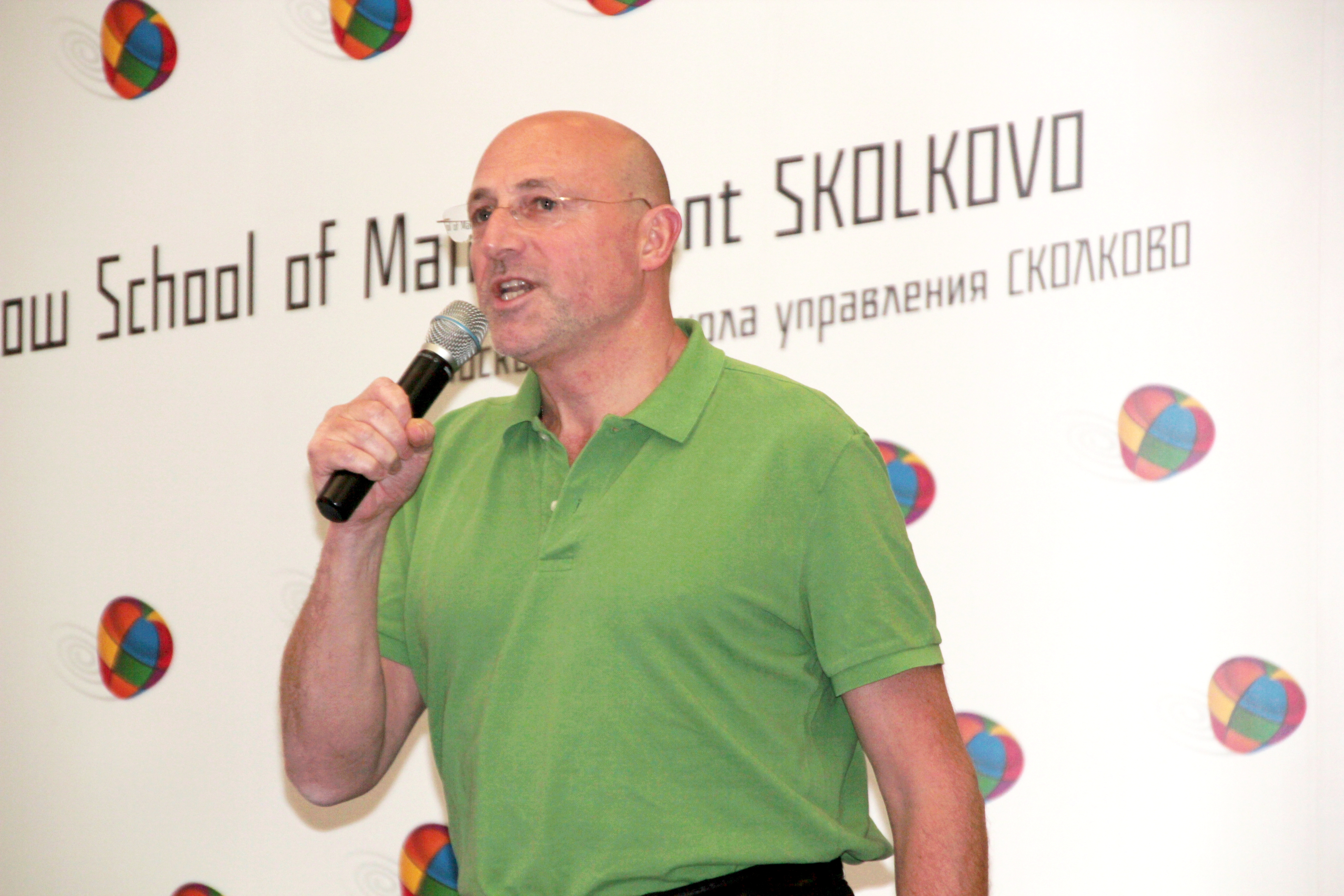
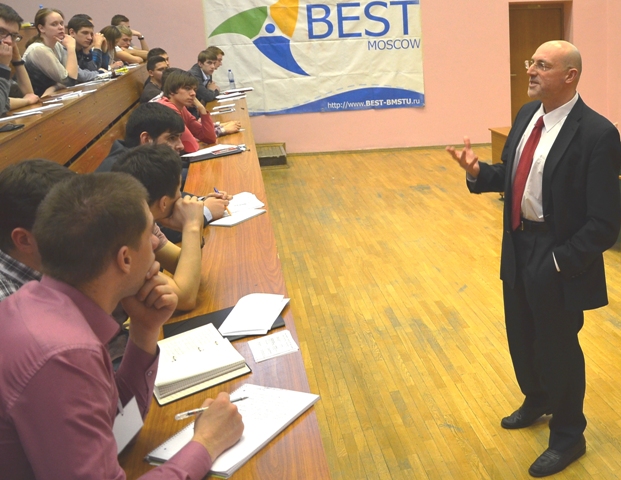
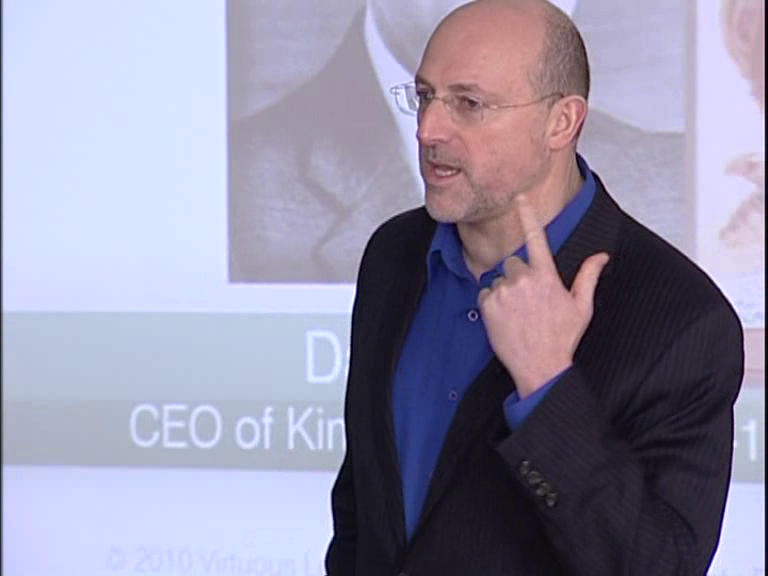
Ignoring the podium on the small stage, Alexandre Havard walked to the front of the room and stood inches from the front row. He paused, looking at the students gathered before him. “Nobody can say, ‘Leadership is not for me,'” he said. “Leadership is not a technique; it is a real life ideal. It’s about becoming who we are: Real human beings.” Havard, founder of the Havard Virtuous Leadership Institute (HVLI) and an international speaker and author, discussed real leadership in his speech, “Virtuous Leadership: An Agenda for Personal Excellence,” at Steubenville University, Wednesday, October 12. Havard, a former lawyer who currently works and teaches in Moscow, Russia, dedicates his life to teaching others about the virtues of true leadership and to answering the question: What does it mean to truly be a human being? Havard explained that leadership is not a quality that only certain people are born with; it is something each and every person can develop. At the heart of real leadership, he said, is not personality, but personal character, which can be built by nourishing specific virtues. “If you ask people what leadership is about, you’ll find that each of us can have his own definition of leadership,” Havard said. “If you are materialistically minded, for you leadership can just be manipulation of people, how to direct people, or how to achieve a goal. What it really is, is a question of character. It has to do with virtues.”  Havard believes that the cardinal virtues—prudence, courage, temperance, and justice—are necessary, but not enough to make a good leader. These, he argued, make rather a “good person”—one who can make right decisions, control his emotions, interact with human beings, and implement decisions. “None of those four virtues are in fact specific leadership virtues,” Havard explained. “They are the virtues of good people. They are important in the life of a leader, but they are important in the life of every human being.” There are two very specific virtues, Havard went on to explain, that every leader must have: magnanimity and humility. Magnanimity, a concept formulated by Aristotle and perfected by St. Thomas Aquinas, emboldens men and women to believe they are worthy of doing great things. To be a real leader, Havard said, one must first have this very specific kind of confidence. “Magnanimity is awareness of the fact that you’re called to do great things in life,” Havard declared passionately. “A leader is a person who first of all has a big vision of who he is—an awareness of his own dignity and greatness. Magnanimity is the virtue of human hope.”
  Here, Havard said, many Christians hesitate, afraid of becoming too proud or self-reliant. That’s why Havard argued that humility is also an essential ingredient in creating the ideal leader. Though they seem contradictory, he explained, magnanimity and humility are in perfect harmony—leaders must first understand their talents, and then realize that their gifts are from God. “If you think that you have great talents and great gifts, but don’t understand that these things have been given to you by God, you are not magnanimous—you are proud,” Havard said. “But if you understand that your good gifts and talents have been given by God, you will investigate more about them, and you are going to multiply them. And you will be filled with gratitude to God.” Havard told the captivated students before him that discovering one’s talents takes time. He advised them to try as many new things as possible, find good friends, and most of all, be confident. “A lot of people are afraid of mistakes,” Havard said. “Magnanimity tells us, don’t be afraid of mistakes! Do a lot of things, and find out what your talent is.” A true leader, Havard said in closing, is one who is not afraid of setbacks or failure, but who remains true to character and virtue and teaches others to do the same. Do this, Havard declared, and all other successes inevitably follow. “At the end of the day, [a true leader can say] even if we collapse as an organization, I did not collapse, and you did not collapse,” Havard exclaimed, “because in this process—of fighting, of struggling, of becoming great—we have achieved our human goals, which are self-transformation, growth, virtue, initiative, creativity, passion. And if, at the end of the day, we lose the battle, I will be happy—not because we lose, but because, you and I, we have become better. We have achieved greatness together.”